
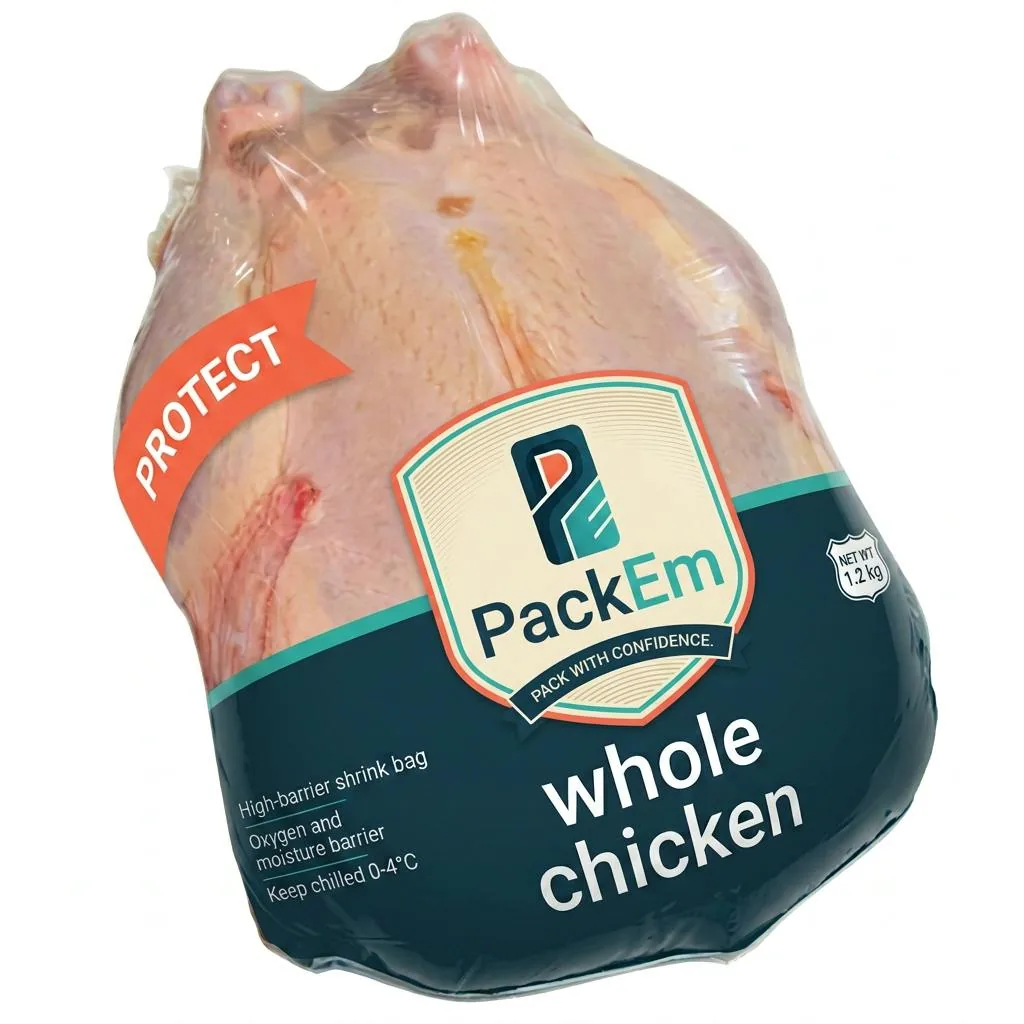
Whole chickens and ducks are awkward to pack. They are irregular, they have bony wing tips and leg ends, and they release liquid as they sit. In supermarkets they also need to look good. A shrink bag solves most of these problems at once, which is why it has become the standard pack for chilled whole birds.
Why shrink works for poultry
After vacuum sealing, the bag is dipped in hot water at around 85 to 90°C for a couple of seconds. The film tightens over the bird, pulling into the gaps between legs and body. There is no loose film for liquid to pool in, so purge stays low and the pack looks clean. The bird keeps its shape, and the label sits flat across the breast.
Barrier and shelf life
Most poultry shrink bags carry an EVOH or PVDC barrier layer. Combined with a good vacuum and an unbroken cold chain at 0 to 4°C, this can extend chilled shelf life well beyond what an open tray or a plain PE bag gives. The exact number depends on the hygiene of the plant and the starting bacterial load, so we always suggest a shelf life trial on your own product.
Protecting against bones
Wing tips and leg bones are the usual puncture points. Tucking the wings behind the back before bagging helps a lot. For heavier birds or long routes, a thicker bag in the 70 to 150 μm range, or a bag with a tougher outer layer, reduces punctures further. Some processors also use a small bone guard on the drumstick ends.
Sizing the bag
A bag that is too big leaves a long tail of film that shrinks into a hard knot and wastes material. A bag that is too small is hard to load and puts strain on the seal. Measure your typical bird by weight band, for example 0.8 to 1.0 kg and 1.0 to 1.2 kg, and size a bag for each band. Printed bags can show the weight class so staff pick the right one quickly.
Printing and branding
Shrink bags can be printed before shrinking. The artwork is distorted on purpose so it looks right once the film tightens. Keep logos and key text in the flattest area, usually the breast, and avoid fine detail near the edges where shrink is strongest.
Ducks and spent hens are often heavier and bonier than broilers, so they usually need the upper end of the gauge range.
Running the shrink tank
Keep the water temperature steady and check it with a thermometer, not just the dial. Water that is too cool leaves wrinkles and cloudy patches. Water that is too hot can weaken the seal or start to cook the skin. Dip time is usually only one to three seconds. After shrinking, chill the birds quickly so the cold chain is not broken.
Getting started
Tell us your bird weights, daily volume, and whether you have a shrink tank or tunnel. PackEm can suggest sizes and gauges and send samples for a trial run.